Call tracking is a powerful tool to analyze and optimize phone interactions with customers. Let's explore the many benefits of call tracking and how it can help businesses of all sizes.
The good news doesn’t end and neither do Voximplant Kit updates. We've recently added several new features that you'll want to check out: two-factor authentication and custom agent statuses. Let's analyze each of them in order.
Voximplant Kit now has a new settings section called Extensions. Now it is much easier to transfer internal calls within your organization. It simplifies the handling of incoming customer calls with call forwarding capabilities. Now you can transfer calls much easier between operators and to the department your customers need.
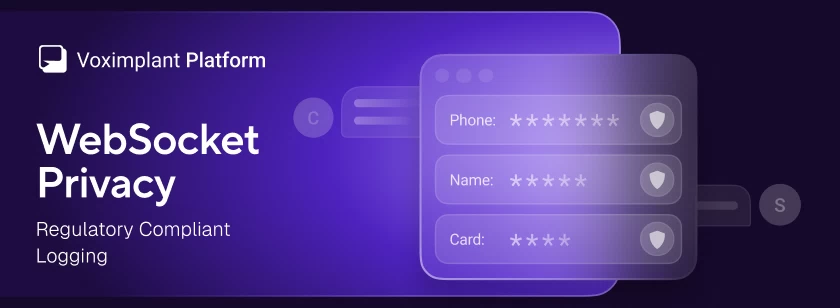
Voximplant has added a WebSocket privacy option that redacts message payloads from logs across all WebSocket-based services – Voice AI connectors and external speech system – and speech control modules
Voximplant has new realtime speech generation for voice AI from Inworld, our latest Voice AI text-to-speech (TTS) partner. Together, we combine state-of-the-art TTS with carrier-grade connectivity so you can build voice agents that sound like your brand, not a generic robot.
Voximplant now includes a native Grok module that connects any Voximplant call to xAI’s Grok Voice Agent API for real-time, speech-to-speech conversations. With a single VoxEngine scenario, you can interact via audio with Grok over phone numbers, SIP trunks and infrastructure, WhatsApp Business, or WebRTC into Grok — all without building custom media gateways or WebSocket streaming infrastructure.
Voximplant now includes a native Cartesia Line / Agents connector that connects any Voximplant call to a Cartesia Line voice agent for real-time, speech-to-speech conversations—over PSTN, SIP, WebRTC, or WhatsApp Business Calling—without building custom media gateways or WebSocket streaming infrastructure.
Voximplant now includes a native Cartesia module for streaming, low-latency text-to-speech (TTS). You can use a single VoxEngine API to synthesize speech in real time, connect it to any call (PSTN, SIP, WebRTC, WhatsApp) and control playback from a Large Language Model (LLM) or other source, all inside VoxEngine.
A practical guide to running a compliant voice AI stack on Voximplant: EU data residency, compliance documentation, and what to verify at each layer — telephony, LLM, STT, and TTS
Voximplant now includes a native Deepgram module that connects any Voximplant call to Deepgram’s Voice Agent API for real-time, speech‑to‑speech conversations. You can stream audio from phone numbers, SIP trunks, WhatsApp, or WebRTC into Deepgram’s unified agent environment—combining STT, LLM reasoning, and TTS—and play responses via Voximplant’s serverless runtime with minimal latency.




 2023-03-20
 29672
29672