VoIP providers minimize latency by supporting point-to-point SIP calls, operating a global POP network and maintaining modern codecs. Dip into our guide and choose your VoIP provider wisely.
Voximplant serverless architecture provides a simpler alternative to deploying traditional VoIP servers in a datacenter. Voximplant APIs offer developers scale and on-demand communications services. Learn how easily you can create VoIP services in the form of Voximplant-based apps.
Now Smartcalls users can choose from a set of affordable plans, integrate with an existing SIP, and enroll into the beta program of Dialogflow and Smartcalls engagement – a next-level solution, that will easily enrich call scenarios with an IVR of any complexity.
Learn how a Voice AI Orchestration Platform connects LLMs, STT/TTS, turn‑taking, and telephony (PSTN, SIP, WebRTC) to build reliable real‑time voice agents. See benefits, architecture, and how Voximplant helps.
Voximplant now includes a native MCP Client for VoxEngine, giving developers direct connectivity to any MCP server and full control over every tool call
Voximplant has new realtime speech generation for voice AI from Inworld, our latest Voice AI text-to-speech (TTS) partner. Together, we combine state-of-the-art TTS with carrier-grade connectivity so you can build voice agents that sound like your brand, not a generic robot.
Voximplant now supports Inworld's Realtime API, so you can bring Inworld's expressive, conversation-aware agents into real phone calls, SIP, and WhatsApp without custom media infrastructure
A practical guide to running a compliant voice AI stack on Voximplant: EU data residency, compliance documentation, and what to verify at each layer — telephony, LLM, STT, and TTS
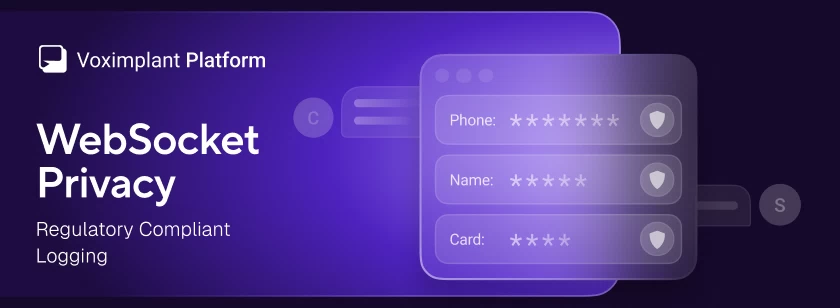
Voximplant has added a WebSocket privacy option that redacts message payloads from logs across all WebSocket-based services – Voice AI connectors and external speech system – and speech control modules




 2020-12-04
 160838