This update brings a new user interface crafted by our UX experts, along with new tools and features for even smarter call processing automation. Let’s walk through the major changes.
Voximplant Kit will soon have a new and improved IVR block with faster and more accurate speech synthesis and recognition. Learn more about the improvements.
Omni channel (“all”, “every”) is a strategy to remove the boundaries between different sales and marketing platforms – traditional street-side, social selling, telecoms, websites, and social media.
According to IDG researchers, 77% of companies today use cloud technology. On the other hand, with increasing popularity, they are becoming more susceptible to cyberthreats. According to Kaspersky Lab, every tenth (10%) leak of data from the cloud was a result of the provider’s actions, while a third of all cyber incidents in the cloud (33%) occurred from employee oversight.
UC (or Unified Communications) are a combination of real-time communication technologies, such as chats and document collaborations, integrated with offline communication methods that do not require the presence of a person (e-mail, voicemail, SMS, fax).
Robotic Process Automation (RPA) is a set of tools that allows companies to automate a range of activities. RPA interprets existing applications and performs tasks traditionally allotted to workers.
Even the smallest businesses make plenty of calls on a daily basis. However, this can interfere with work processes and make collaborations less productive. Adopting a technology capable of solving inconveniences associated with traditional phone systems can potentially be a huge benefit. Voice over Internet Protocol (VoIP) allows businesses to make calls over a computer or other data-driven devices. Also, it offers call forwarding, caller ID, voicemail, SMS, and video calls.
A practical guide to running a compliant voice AI stack on Voximplant: EU data residency, compliance documentation, and what to verify at each layer — telephony, LLM, STT, and TTS
Voximplant now includes a native Deepgram module that connects any Voximplant call to Deepgram’s Voice Agent API for real-time, speech‑to‑speech conversations. You can stream audio from phone numbers, SIP trunks, WhatsApp, or WebRTC into Deepgram’s unified agent environment—combining STT, LLM reasoning, and TTS—and play responses via Voximplant’s serverless runtime with minimal latency.
Connect any OpenAI-compatible text LLM to your voice AI pipeline in VoxEngine via Chat Completions or Responses API. Set baseUrl to any provider or your own deployment, including EU endpoints for data residency
Voximplant now includes a native Cartesia module for streaming, low-latency text-to-speech (TTS). You can use a single VoxEngine API to synthesize speech in real time, connect it to any call (PSTN, SIP, WebRTC, WhatsApp) and control playback from a Large Language Model (LLM) or other source, all inside VoxEngine.
Today Ultravox announced they are directly integrating Voximplant into their platform to provide SIP capabilities. The integration builds on Voximplant’s deep telephony and Voice AI tooling
Voximplant now includes a native Cartesia Line / Agents connector that connects any Voximplant call to a Cartesia Line voice agent for real-time, speech-to-speech conversations—over PSTN, SIP, WebRTC, or WhatsApp Business Calling—without building custom media gateways or WebSocket streaming infrastructure.
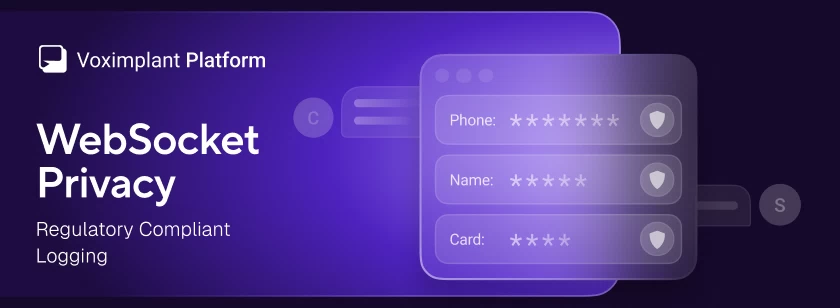
Voximplant has added a WebSocket privacy option that redacts message payloads from logs across all WebSocket-based services – Voice AI connectors and external speech system – and speech control modules




 2020-02-04
 190756